


What an SR Linux fabric looks like, what is wrong with it, and what changed, straight from gNMI.
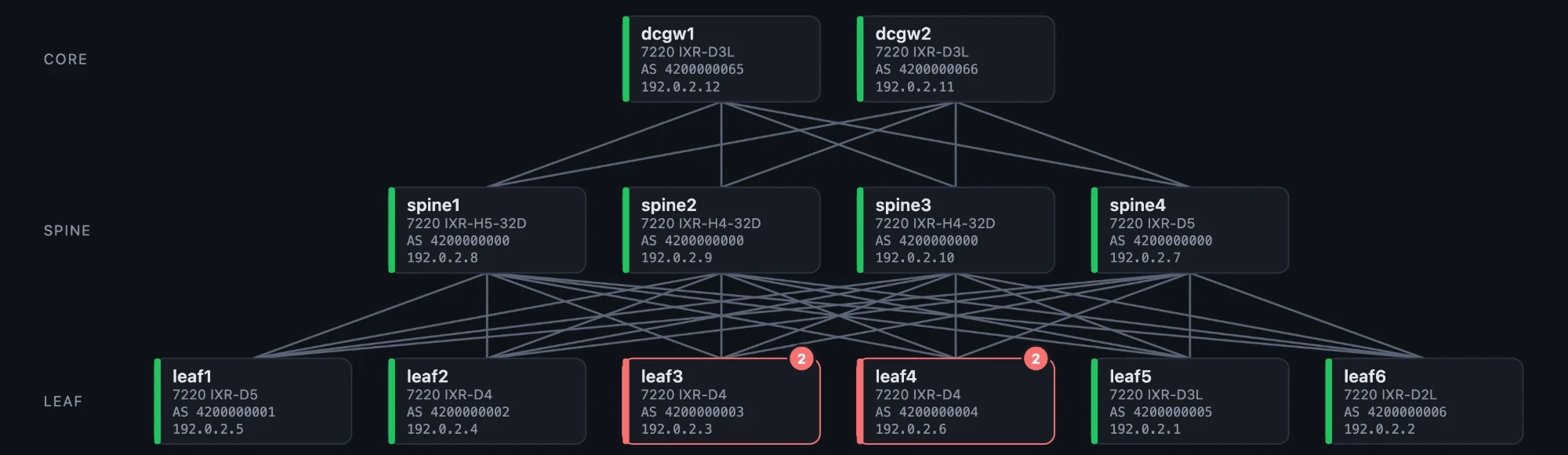
This replaces fcli, rewritten from the ground up. It runs on asyncio throughout, uses no Nornir and makes no blocking gNMI calls. On top of fcli's reports, it adds a streaming engine with history, fabric checks grouped into incidents, fabric-wide lenses, a web UI, and an MCP server and agent.
It needs Python 3.11 or later, and gNMI enabled on the nodes. It is tested against SR Linux 25.3 to 26.7.
Install the fcling command once, then run it from anywhere:
uv tool install fcling # or `pipx install fcling`; `uv tool install .` from a checkoutOr run it with Docker, without installing anything:
docker run --rm --network host -v "$PWD:/work" ghcr.io/srl-labs/fcling -t lab.clab.yml bgp-peersThen:
fcling -t lab.clab.yml bgp-peers
fcling -t lab.clab.yml -i role=leaf -o json subif -f oper=down
fcling -c inventory.yml sys-info
fcling -t lab.clab.yml ipv4-rib -a 10.1.3.99          # longest-prefix match
fcling -t lab.clab.yml bgp-rib -r evpn -t 5 -d        # with the detail columns
fcling -t lab.clab.yml ifstats -s 2 -f oper=up        # rates over 2 s
With the engine running, the same commands answer instantly from what it streams, and can look back:
fcling -t lab.clab.yml serve                          # streams every node, keeps history
export FCLI_SERVER=http://127.0.0.1:8765
fcling bgp-peers                                      # live, from the engine
fcling bgp-peers --at 14:02                           # as it was then
fcling history --since 1h -r bgp-peers --follow       # what changed, which commit did it, and keeps watching
fcling serve also serves a web UI at http://127.0.0.1:8765/: the topology, incidents, history, lenses, every report and the agent, in a browser.
What is wrong, and what changed:
fcling checks                          # every finding, check by check
fcling incidents -v                    # grouped by root cause, worst first
fcling incidents --at 14:02            # what was wrong then
fcling baseline pre-change -m "before the MTU change"
fcling drift pre-change                # what came, went and changed since
fcling config-diff leaf1 12             # what commit 12 did to leaf1's configuration, side by side
Ask, or let your own AI client ask. Both get the same 14 read-only tools: status, reports, incidents, checks, history, configuration diffs, drift, baselines, the lenses and the topology.
export ANTHROPIC_API_KEY=...                                     # or OPENAI_API_KEY, XAI_API_KEY: for `fcling serve` too, to use Ask in the UI
fcling ask "what is wrong, and what changed just before?"        # the first provider with a key
fcling ask --provider openai --effort low "is BGP healthy?"
claude mcp add --transport http fcling http://127.0.0.1:8765/mcp        # MCP over HTTP from `fcling serve`
claude mcp add fcling -- fcling --server http://127.0.0.1:8765 mcp        # or over stdio
Questions across the whole fabric, and its shape:
fcling -t lab.clab.yml where 10.1.3.13                        # every place that knows an IP or MAC
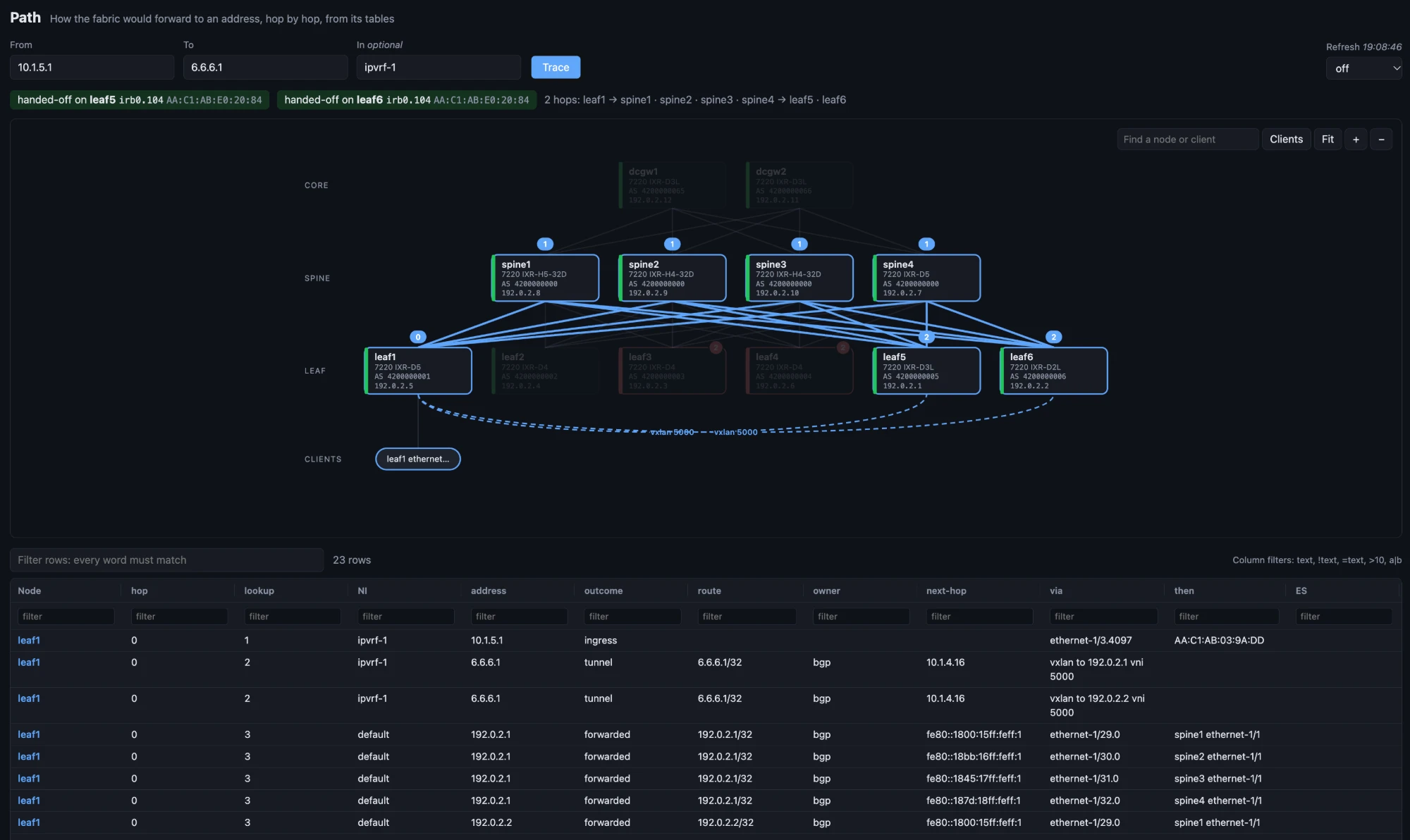
fcling -t lab.clab.yml path leaf1 10.1.3.13 --ni ipvrf-1      # hop by hop, over ECMP and VXLAN
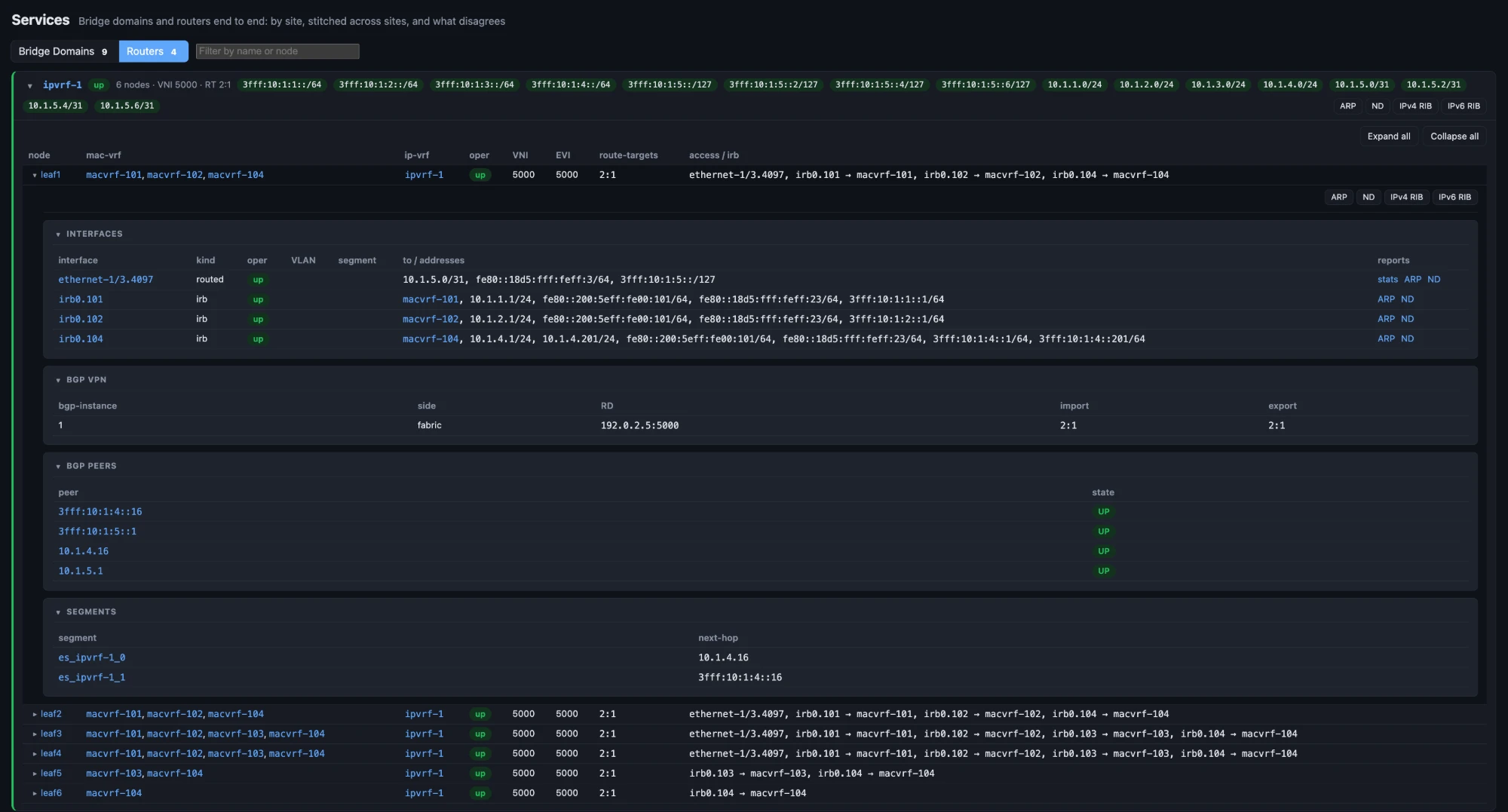
fcling -t lab.clab.yml service macvrf-102                     # one service on every node, and what disagrees
fcling -t lab.clab.yml endpoints                              # every attached host
fcling -t lab.clab.yml topology                               # tiers, cables, clients, segments
path in the web UI: the trace drawn on the topology, over ECMP and the VXLAN tunnels, with every lookup in the table below it.
A router end to end: its interfaces, BGP VPN, peers and segments on each node, with links to the ARP, ND and RIB reports.
checks and incidents work without a server too: one-shot from the nodes, or from the local history with --at. They exit 1 when there is an error, so they can gate a pipeline.
Reports: sys-info, config-commits, lldp, subif, lag, ifstats, ni, bgp-peers, bgp-rib, ipv4-rib, ipv6-rib, tunnel-table, static-routes, routing-pol, mac, arp, nd, irb, es, es-dest, vxlan, bfd, isis, ospf, resources, components, transceivers, services, bridge-domains, routers. Each is a pure function from gNMI paths to typed records.
Each release below is tested on every change by replaying real gNMI recordings, so the tests need no lab. CI runs 25.10, 26.3 and 26.7 as a job each.
| SR Linux | Rows match the original fcli | fcling's own reads and subscriptions |
|---|---|---|
| 25.3 | 25.3.2 (2 nodes) | - |
| 25.10 | 25.10.3 (2 nodes) | 25.10.4 (3 nodes), 25.10.5 (1 node) |
| 26.3 | 26.3.1 (4 nodes) | 26.3.1 (2 nodes) |
| 26.7 | 26.7.1 (2 nodes), 26.7.2 (2 nodes) | 26.7.2 (2 nodes) |
The first column replays the Gets the original fcli made, and requires the same rows it rendered. The second is fcling's own exchange with a live node: which paths a release refuses, which reads come back empty, whether the subscriptions sync, and which fields stop being filled from one release to the next. Layouts before 24.10 are not supported. MATRIX.md has what each lab covers, what differs between releases, and how to record a new one.
| Installation and inventory | installing, containerlab and static inventories, selecting nodes, TLS |
| Reports | every report, filters, output formats |
| The web UI | topology, incidents, history, lenses, reports and the agent in a browser |
| The engine | fcling serve: how it streams, the HTTP API and its events, security |
| History | what is kept, --at, commit attribution, baselines and drift |
| Lenses and topology | where, path, service, endpoints, topology, adding a lens |
| Checks and incidents | every check, and how findings are grouped by root cause |
| MCP and the agent | the tools, MCP setup, fcling ask, and the variables for Claude, OpenAI and Grok |
| Architecture | how it fits together, adding a report or a check, the tests |
inventory ──► collect (one-shot) ──┐
          └─► engine (streaming) ──┼──► Tree per node ──► reports ──► records ──► render / API / tools
                                   │                         ▲
            history (SQLite) ◄─────┘   checks over all nodes ┘──► findings ──► incidents
- A report never does I/O. It declares the gNMI paths it reads and builds typed records from a tree. The same definition runs one-shot (a Get per datatype, every node at once), streamed (Subscribe in
fcling serve) and on recordings in the tests. - Records are flat, frozen pydantic models. One record is one row. It gives the JSON output, the schema that MCP clients and the API publish, and the key that history and drift compare by.
- Every surface goes through one Service and one tool layer. The CLI, the HTTP API, the web UI, MCP and the agent all see the same fabric.
docs/architecture.md has the module map, and covers adding a report or a check.
make test lint          # pytest, then ruff and mypy
make proto              # regenerate the gNMI stubs (they are committed)
No lab is needed. tests/fixtures/releases holds real gNMI recordings from SR Linux 25.3 to 26.7, made with the original fcli. test_release_matrix.py replays them through the new reports and requires the same rows the original rendered. tests/fixtures/reads holds fcling's own recordings, which test_release_reads.py checks release by release. fake_gnmi.py is an in-process gNMI target that the client, TLS, the collector, the engine, the server and the CLI are tested against. MATRIX.md explains what each set of recordings checks.
BSD-3-Clause, see LICENSE.