
A production-style Retrieval Augmented Generation (RAG) system designed for scalable document ingestion, advanced retrieval pipelines, and API-based querying.
This project demonstrates how to build an end-to-end intelligent retrieval system capable of processing large document collections and generating grounded responses using LLMs.
The system is divided into three main modules:
- rag_ingestion → Handles document processing and indexing
- rag_retrieval → Implements the retrieval and ranking pipeline
- service → Provides API services, caching, and security
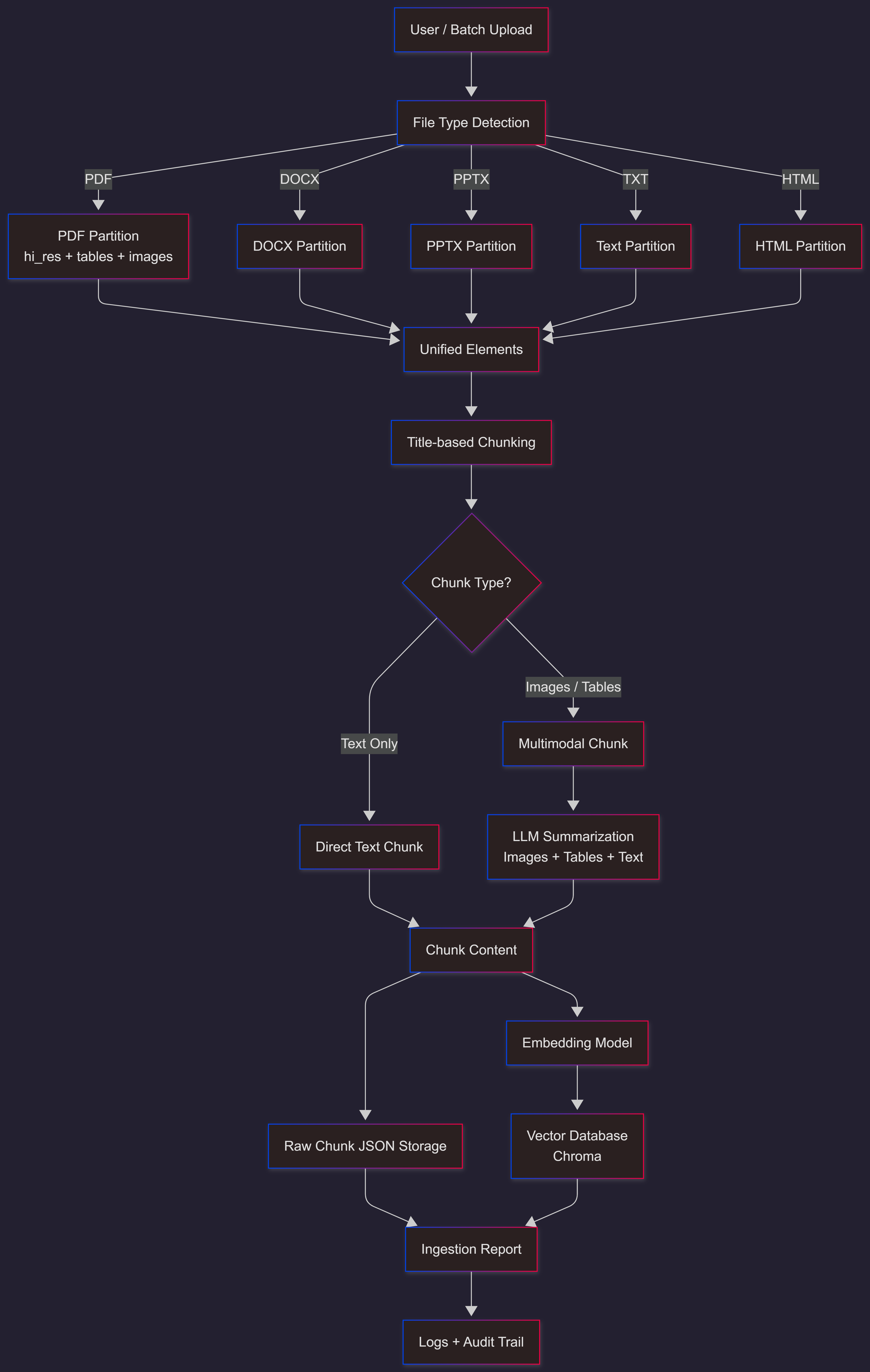
Splits documents into structured sections such as paragraphs, headings, and tables.
Breaks documents into smaller segments suitable for embedding.
Ensures chunks meet quality and size constraints.
Generates condensed representations of document sections.
Transforms chunks into vector embeddings using embedding models.
Stores embeddings in a vector database for semantic retrieval.
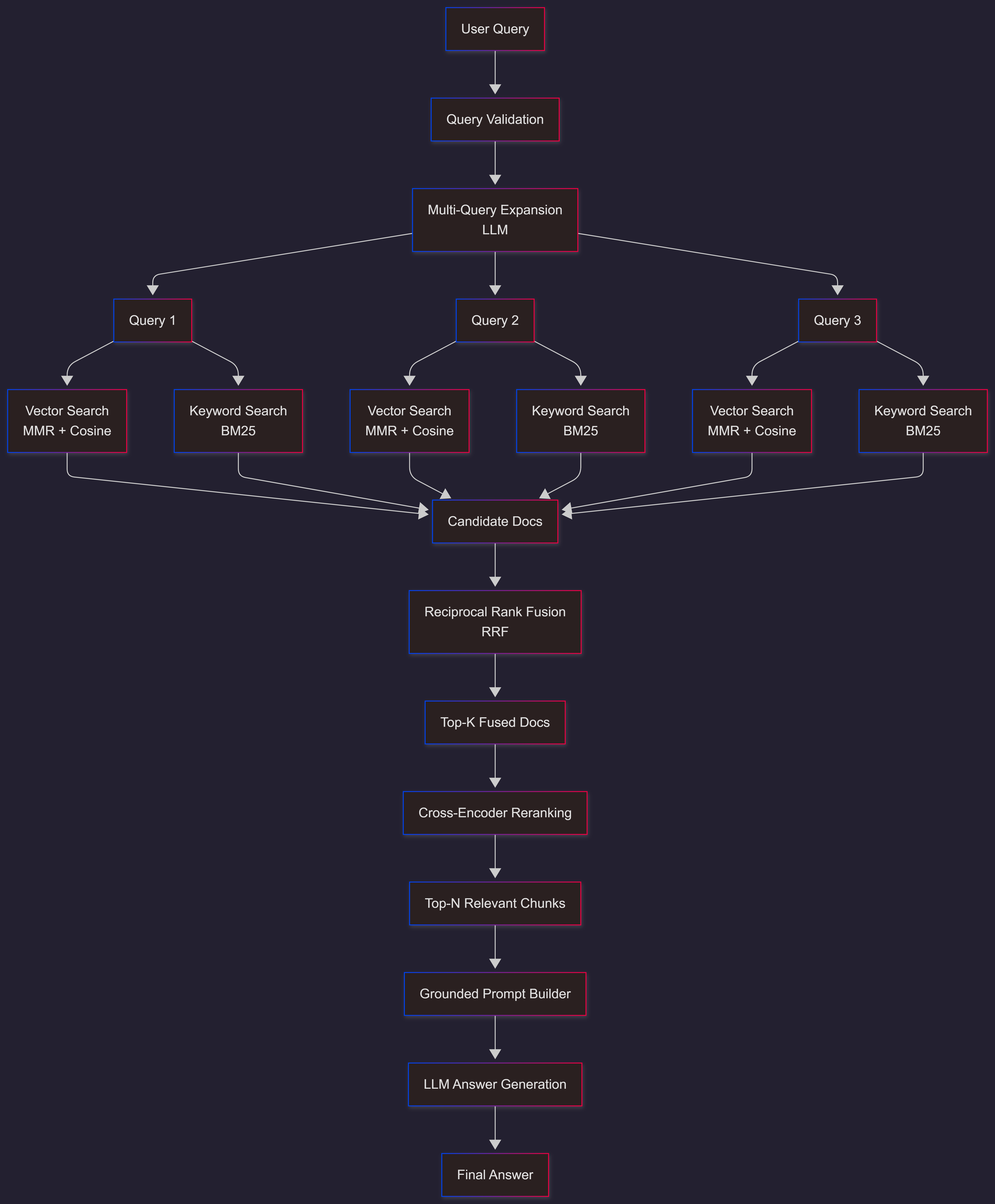
Generates alternative queries to improve recall.
Combines:
- Vector search
- Keyword search
Merges results from multiple retrieval methods to improve ranking.
Ranks retrieved results based on semantic relevance.
The service module exposes the RAG system through APIs and manages system-level features.
- Query normalization
- Semantic caching
- Redis integration
- Security and authentication
- Tenant validation
- Evaluation pipeline for retrieval quality
- Streaming LLM responses
- Docker deployment
- Observability and monitoring
- Multi-modal retrieval extensions
Advanced Retrieval Techniques
- Query Expansion
- Hybrid Retrieval
- Reciprocal Rank Fusion
- Reranking
Production Features
- API-based architecture
- Semantic caching
- Modular pipeline design
- Security layer