
rustlane brings an ISPC-style SPMD programming model to Rust as a pure
library — you write natural scalar-looking control flow (if, while,
for, break, early return) over varying values, and proc macros lower it
to masked SIMD over nightly std::simd. No compiler fork, no external
toolchain: just #[kernel], #[export], and foreach!.
rustlane is an independent project, not affiliated with Intel.
Experimental. Nightly-only. The API is unstable and will change without notice.
The SPMD idea: write one program as if it runs on a single lane, and the
library runs it across a whole SIMD vector of lanes at once. Control flow that
diverges between lanes is handled for you. Here is the Mandelbrot escape-time
kernel — plain for / if / break over varying values:
use rustlane::prelude::*;
use rustlane::kernel;

#[kernel]
fn mandel(c_re: Varying<f32>, c_im: Varying<f32>, count: i32) -> Varying<i32> {
    let mut z_re = c_re;
    let mut z_im = c_im;
    let mut ret = Varying::splat(0);
    for i in 0..count {
        if z_re * z_re + z_im * z_im > 4.0 {
            break;
        }
        let new_re = z_re * z_re - z_im * z_im;
        let new_im = 2.0 * z_re * z_im;
        unmasked! {
            z_re = c_re + new_re;
            z_im = c_im + new_im;
        }
        ret = i + 1;
    }
    ret
}
The macro rewrites this into masked std::simd: the varying if/break
become per-lane mask updates and blends (ret = i + 1 stores only into lanes
still iterating), and the for loop keeps running until every lane's mask is
off, so a lane that has already escaped stops contributing without stopping the
others.
Nightly only. Select the nightly toolchain and add rustlane to your dependencies:
# rust-toolchain.toml
[toolchain]
channel = "nightly-2026-08-07"

# Cargo.toml
[dependencies]
rustlane = "0.1.1"
The repository pins this known-good nightly for reproducible builds.
A #[kernel] is the per-lane program; an #[export] is the all-uniform entry
point that drives it with foreach! and is callable as an ordinary safe Rust
function:
use rustlane::prelude::*;
use rustlane::{export, kernel};

#[kernel]
fn scale(x: Varying<f32>, factor: f32) -> Varying<f32> {
    x * factor
}

#[export]
fn scale_all(input: &[f32], output: &mut [f32], factor: f32) {
    foreach!(i in 0..input.len() {
        output[i] = scale(input[i], factor);
    });
}

fn main() {
    let input: Vec<f32> = (0..1024).map(|v| v as f32).collect();
    let mut output = vec![0.0f32; input.len()];
    scale_all(&input, &mut output, 2.0);
    assert_eq!(output[10], 20.0);
}Seven kernels from ISPC's own example suite (options contributes two),
measured against Intel ISPC on two machines. #[export] dispatches to the
widest target the CPU supports — 8 lanes on the M2 Pro, 16 on the Zen4 box —
and the ISPC target at that same width is the orange bar.
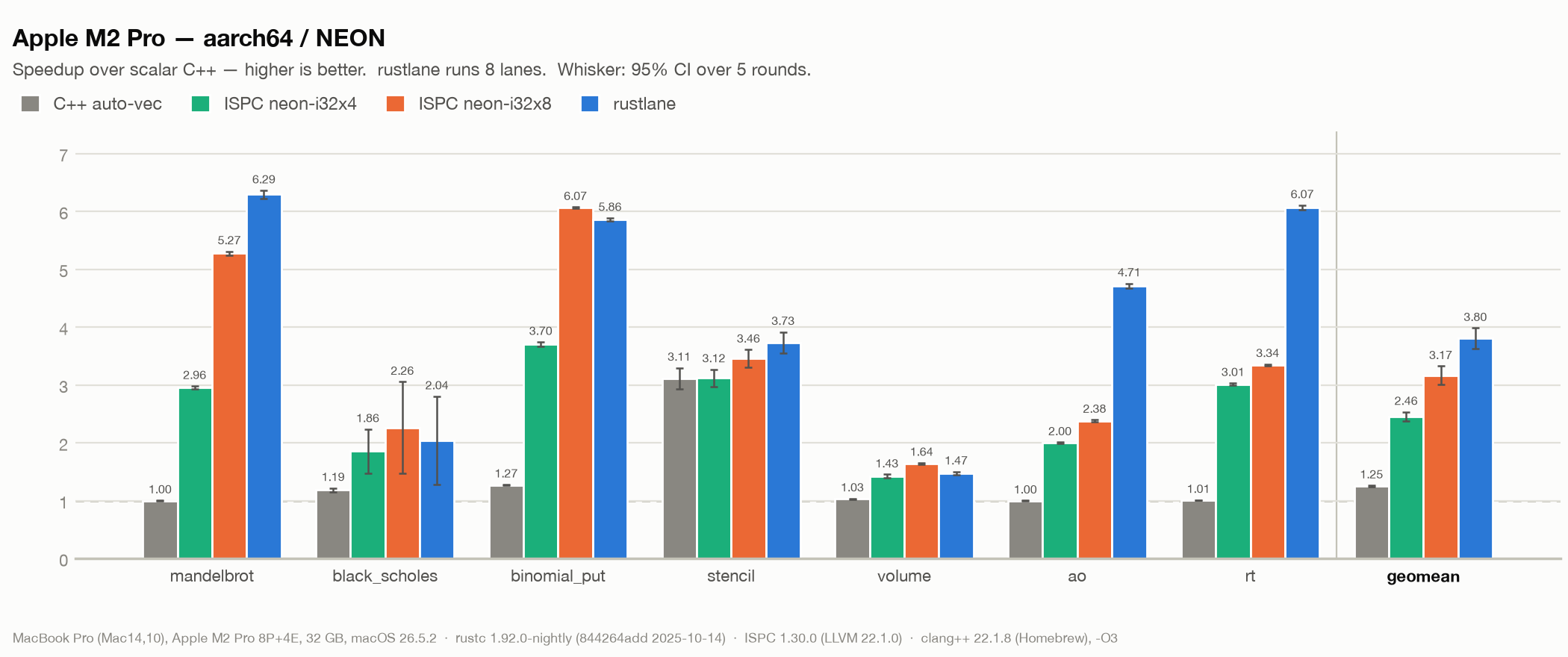
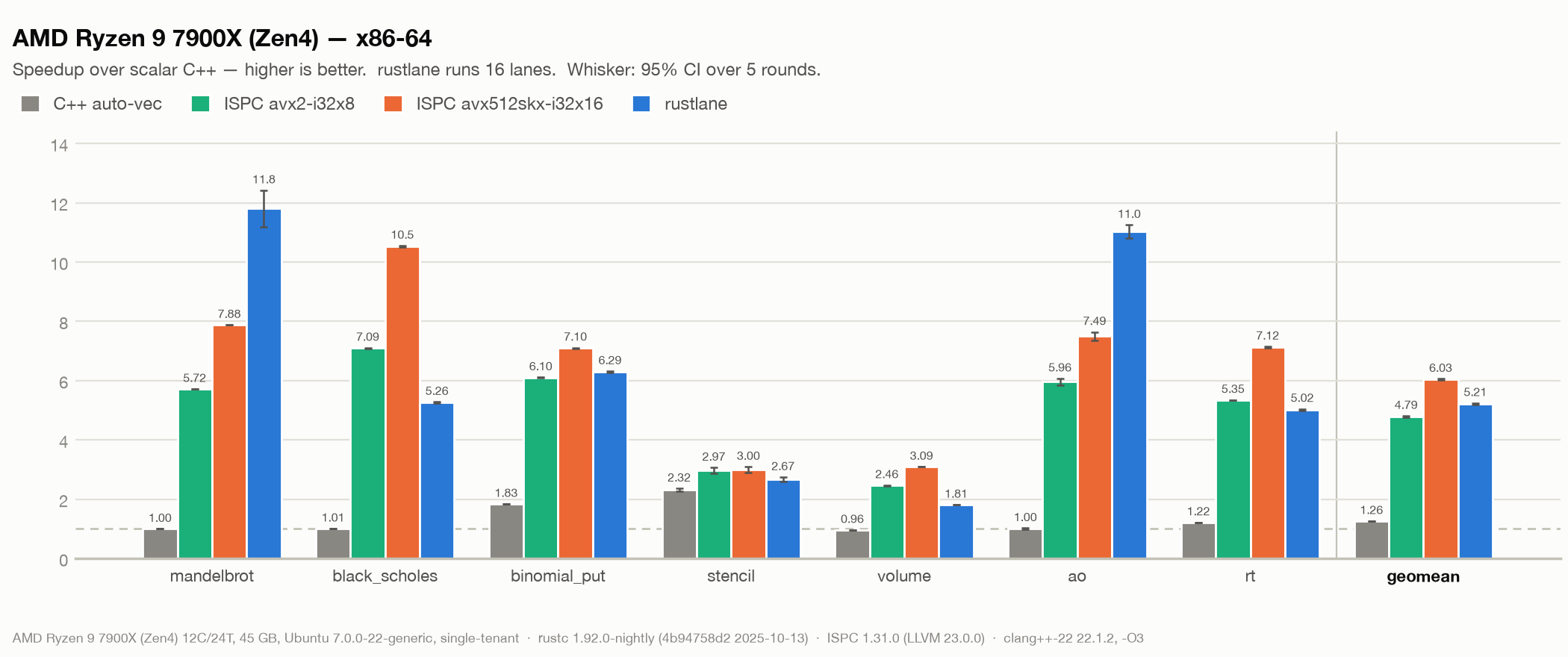
Geometric mean of rustlane / ISPC runtime at matched width:
| Machine | rustlane | ISPC | ratio |
|---|---|---|---|
| Apple M2 Pro | 8 lanes | neon-i32x8 |
0.83 |
| AMD Ryzen 9 7900X (Zen4) | 16 lanes | avx512skx-i32x16 |
1.16 |
Each round is 3 warm-up reps plus an internal min-of-15 (mandelbrot: 20); five
rounds run interleaved over every binary in a fixed order with 2 s cool-downs.
Bars are the mean over the five rounds, whiskers a 95% t interval. Every round
validated its output against the ISPC reference. Full toolchain versions are
printed under each chart; per-round raw timings land in results/<arch>.csv.
The C++ columns are the same source at -O3; scalar adds
-fno-vectorize -fno-slp-vectorize.
make -C ispc-ref build-all       # ISPC + C++ baselines (needs ispc, clang++)
cargo build --release
./rustlane-bench/measure.sh      # ~25 min
python3 rustlane-bench/parse_measurements.py aarch64   # or x86_64
python3 rustlane-bench/make_charts.py aarch64 # or x86_64if/elsewith divergent (varying) conditionswhile(varying condition) /for/ bareloop, withbreak/continue/ earlyreturnunder divergenceunmasked! { .. }— an all-lanes block, for loop-carried localscif!/cwhile!— aliases for maskedif/whileforeach!/foreach_2d!/foreach_tiled!— inline iteration, no closures#[derive(SpmdValue)]— a struct vectorizes to a generated SoA typeVaryingS<N>;#[spmd(uniform)]keeps a field scalarmath— ISPC-ported transcendentals (exp/log/pow/sin/cos/rsqrt/rcp)rng— LFSR113 combined-Tausworthe varying RNGreduce— horizontal reductions and mask predicateslanes— lane indices, broadcast / extract / insert / rotate / shift / scanmemory— masked loads/stores, gather/scatter, and packed active-lane access- Runtime target dispatch: SSE2 / SSE4.1 / AVX2 / AVX-512 on x86-64, NEON on aarch64
Nightly is required and will stay required because Varying<T, N> is built on
the unstable portable SIMD API. Applications only need
#![feature(portable_simd)] when they use std::simd directly.
The runtime refactor introduces breaking changes for code that calls or
implements the lowering traits directly. Kernel syntax and the README examples
are unchanged, as are ordinary math, memory, reduction, and RNG calls
(rng::RNGState, seed_rng, random_u32, frandom).
| Previous API | Replacement |
|---|---|
EnterLoopN::<N>::enter_loop_n(exec) |
VaryingLoop::<N>::from_exec(exec); accepts ActiveMask<N> |
Refresh::refresh |
RetainActiveLanes::retain_active_lanes |
SpmdLoop::current |
SpmdLoop::iteration_exec |
SpmdLoop::iter_mask() |
Copy the loop state directly: let mut iteration = loop_state; |
LoopRemove::remove |
LoopRemove::remove_active_lanes |
MinMaxElem::vmin / vmax |
MinMaxElem::simd_min / simd_max |
ReduceElem::vreduce_add / vreduce_min / vreduce_max |
ReduceElem::reduce_sum / reduce_min / reduce_max |
ActiveMask::all_known_active |
Removed unused optimization hint; remove overrides and calls |
MinMaxElem is in math; ReduceElem is in reduce. The execution traits
remain available from the crate root, exec, and the prelude.
Lane operations now live in lanes; packed_load_active and
packed_store_active live in memory. Their existing reduce::… paths remain
re-exported. ActiveMask now lives in exec; its crate-root, prelude, and
memory::ActiveMask paths remain available.
Varying<S>for a structS.Varying<T, N>isrepr(transparent)overSimd<T, N>, soThas to be a scalar. Structs go through#[derive(SpmdValue)]to SoA instead.matchand enum pattern matching are not implemented. Useif/elsefor now.- Explicit generic arguments on a kernel call (
k::<8>(x)). The macro supplies::<N, _>itself.
- An empty-mask kernel call skips its body and returns
Default::default(); kernel return types must implementDefault. unmasked!enables all lanes in a reached block; it does not enter skipped branches or resurrect a completed function.- Varying branches execute only when at least one lane is active. The
thenarm executes before theelsearm; uniform side effects occur once per nonempty arm. &&and||evaluate their RHS with a narrowed execution mask and skip it when no lanes need the result.- Division and remainder mask inactive operands before evaluation. Active operands retain Rust's scalar or portable SIMD arithmetic behavior.
- Uniform assignments and uniform-index stores execute once if any lane is active. Assigning a varying value to a uniform variable requires an explicit reduction or lane extraction.
- Safe memory access panics on active out-of-bounds indices in debug and release. Inactive lanes never access memory. Unchecked access requires every active index to be in bounds.
- Conflicting scatters keep the highest active lane's value. Compound indexed
assignments gather before scattering; use
memory::scatter_addwhen every conflicting contribution must accumulate. - Ordinary Rust calls do not receive an execution mask and are not implicitly invoked once per lane. Mutations inside such calls are not lane-masked.
Compile-fail snapshots check unsupported syntax and type combinations, including implicit varying-to-uniform assignment and varying export signatures.
Each execution context (all-on, a uniform branch bool, a varying mask, a
uniform branch under a varying mask) is a distinct Rust type that the macro
threads through the kernel as a hidden first parameter; every operator,
assignment, and control-flow construct resolves against that type by trait, so
the macro itself never inspects a value or a type. Because the context is a
type and the "is this uniform?" test is a const, monomorphization deletes the
mask machinery on every path that turns out uniform: a kernel entered all-on
compiles down to plain scalar branches and contiguous vector loads, with blends
emitted only where control flow is divergent. Branch guards skip empty masks
so uniform side effects do not run in empty branches. These checks add a
reduction to varying branches; their performance cost needs measuring against
ISPC. The whole kernel tree is #[inline(always)], so #[export] can stamp it
out once per SIMD target inside a #[target_feature]
shim and pick the widest at runtime with a single cached indirect call.
Licensed under the MIT License.
Portions of the benchmark kernels and math routines are ported from Intel's ISPC examples under their original BSD-3-Clause terms; see THIRD-PARTY.md for the full attributions.